
Journalism to PA School: Kate's First-Cycle Acceptance Story (Career Change at 30)
Journalism to PA School: Kate's First-Cycle Acceptance Story (Career Change at 30)
By: Savanna Perry, PA-C
Kate earned a journalism degree from UNC-Chapel Hill, worked in media for eight years, and decided in 2015 to change careers. She completed roughly 100 post-baccalaureate credits at a 3.89 GPA plus a nine-month surgical technology program, then applied to twelve schools with only 500 patient care hours. Two interviews, an acceptance at one of her top choices, and three further interview invitations she declined.
Last Updated: August 3, 2026
Your Pre-PA Bestie Blog - everything you need to know to become a PA in one place.
How many programs did you interview with and what were the outcomes?
I only went to two interviews, and they were in the same week. I really didn’t click well with the first one – neither the location nor the program, but it was great practice. The interview later in the week was for one of my top schools, and I felt very confident going in to it. I loved everything: the city, the students, the staff, the program. They told me at the end of the day that I was in! It was an incredible day. At this point, I’ve received three other interview invites, which I’ve declined.
Any red flags on your application?
Not having enough PCE/HCE. Because I was a little older going in to this, and I knew it would take two years to get my prereqs done and start working as a Surgical Tech, I really focused on getting in on the first cycle. Every program I applied to emphasized a holistic look at applicants. I expect to have 1000+ PCE hours by the time I start PA school, but I knew it would be seen as a weak point on my application not having a lot of hours when I submitted.
Also, my undergrad overall GPA was a 3.1 and I had several low grades (one D and a few Cs). They were in courses like Law and Economics – so I really didn’t stress about programs caring about those grades (and none of them mentioned them). Because I took SO many credit hours post-Bacc, that GPA came up significantly, and I don’t think my GPAs were any kind of red flag.
In our experience at The PA Platform, the post-baccalaureate route is the most reliable way for career changers to fix an undergraduate GPA, and Kate's numbers show why. Her undergraduate GPA was 3.1 with a D and several Cs; roughly 100 post-bacc credits at a 3.89 pulled her cumulative to 3.45 and her science GPA to 3.69. Volume matters here — a handful of new courses barely moves a cumulative average, while a full year or two of strong coursework transforms it. [VERIFY] Confirm how each program calculates GPA and whether it considers the most recent credits separately.
Anything you found surprising about interviews?
The parts that I thought I would be most nervous about – the actual interviews – turned out to be the most comfortable. What really made me nervous was waiting around! At my second interview, I waited for more than an hour to get called into the group interview and several hours again for my individual interview. I was a mess – I think we all were. I tried to get to know the other interviewees while we waited and just chatted about anything/everything just to take our minds off of being so nervous waiting.
Every Pre-PA Should Know...
Two of Kate's four letters came from a former boss and a former manager in journalism, not from healthcare. She kept those relationships alive for years, so by the time she asked, they understood her career change and could write about which of her strengths transferred. Non-clinical letters work when the writer can draw that line explicitly.
****INSERT FREE LEAD MAGNET FORM OR HTML BLOCK AND DELETE TEXT BOX*****
Were there any helpful resources (books, websites, apps) you used to get through prerequisite courses, the application or interview process?
At my interviews, the staff really just wanted to get to know you. When preparing for interviews, definitely be ready to talk about why you want to be a PA, and why you like their program. But apart from that, just be able to comfortably talk about yourself and your own strengths and interests. I’d say the very best practice you can have is to have those conversations with your family and friends over and over – literally practice this for months. Get used to talking easily about why you want to be a PA, and practice talking about yourself in a non-egotistical way. If it feels comfortable to talk about those things casually with your friends, you’ll come across as confident (but not cocky) during your interview.
Any other advice for other pre-PA students?
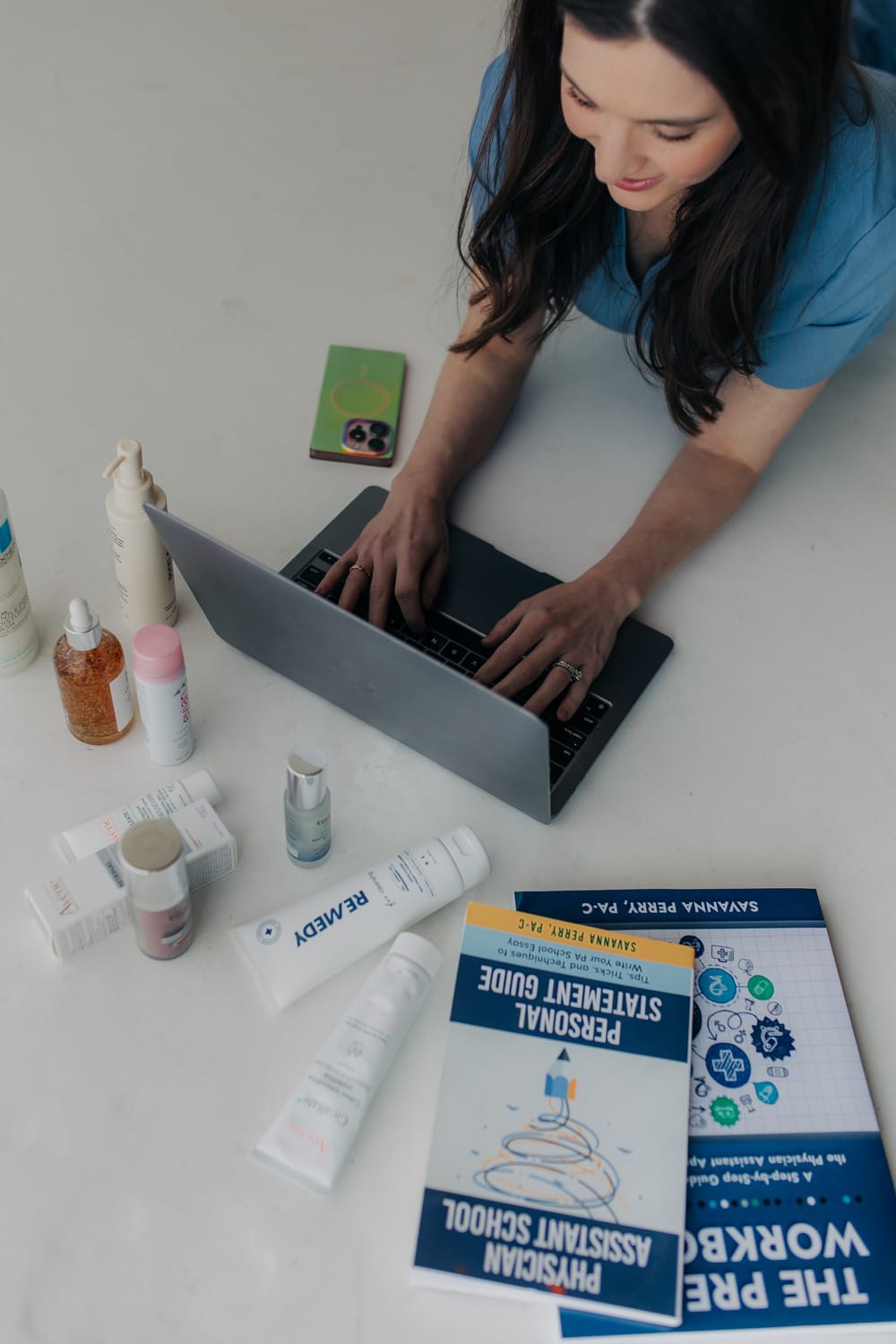
With my background in writing, I want to take a moment to talk about personal statements. I realize this goes against a lot of the advice that’s out there (and of course, this is just my opinion and I don’t claim to be an expert). It seems that the trend has been to start off personal statements with a dramatic story or hook. Things like: “It was a cold and rainy night and the lights from the ambulance were all I could see…”. I really do not think that is necessary. You need to show why you are going to be a great PA student and practicing PA. If you’ve got a good story, and that story plays a huge part of why you want to be a PA, go for it. But eliminate the drama and the adjectives. Cut to the chase. The admissions committees don’t care if you can write a good story, they care if you’re going to be a strong student and have what it takes to become a PA. I’m not saying you should just write out a list of reasons you want to be a PA and call it a day. You should be able to write well about why you’re passionate about becoming a physician assistant. Write it in your own voice and avoid clichés.
The personal statement plays a huge part in getting that interview invite, and the schools just want to get a better understanding of who you are aside from your grades and experiences. It’s your personality that should jump off the paper, not your ability to write a good story. My opener on my personal statement was: “I have always had an interest in medicine, but I didn’t know until just a few years ago that it was a path I would pursue myself.” Then I spent the rest of it talking about my path and how I realized becoming a PA was right for me. Straight to the point of addressing what makes me a unique applicant.
Listen: Dietitian to PA Student of the Year to PA - with Cassidy
Cassidy was a clinical registered dietitian. Then she became AAPA's 2022 PA Student of the Year.
Cassidy was a clinical registered dietitian. Then she became AAPA's 2022 PA Student of the Year.
Her dietitian background wasn't a detour. It was direct patient care, in a hospital, with real clinical responsibility - exactly the kind of experience that makes an applicant credible. She graduated from Missouri State and clearly made the most of it.
What I want you to take from this one is how deliberately she picked her schools. Not by ranking. By program size, tuition, and how much support students actually get. Those three things shape your next two years far more than a name does.
She was also proactive about landing her first PA job. She networked during rotations instead of waiting for postings to appear after graduation. That's how most good first jobs happen.
What we cover:
Working as a clinical dietitian and using it as patient care experience
Choosing programs by size, cost, and student support
What being PA Student of the Year involved
Getting the most out of PA school beyond grades
Networking during rotations to find your first job
Advice for anyone coming from another healthcare field
Resources
Follow The Pre-PA Club: Apple Podcasts · Spotify · All episodes
Where can we find you?
I have an Instagram account that I hope to expand with pre-PA tips over the next year, and then document my time in PA school when I start next fall. You can follow along at @kate.pa_s
Need to Know:
Undergraduate education: I received my B.A. in Journalism with a minor in creative writing from UNC-Chapel Hill eight years ago. Since then, I’ve worked at various media outlets. Unfortunately, there isn’t much job stability in journalism, and I was on the hunt for a new career that I could be passionate about that had better job prospects. I decided in 2015 that I wanted to go to PA school, and started working on prereqs. I also applied to a Surgical Technology program – it was something I was interested in and the program was only 9 months, so it was a quick(ish) way for me to start working toward clinical experience.
Overall GPA: 3.45
Science GPA: 3.69
Post-Bacc GPA (100 semester credit hours): 3.89
GRE: 155/155/5.0
Total HCE hours: 100+ hours volunteering in PACU and the OR at Level I Trauma Center
Total PCE hours: 500 hours as a Surgical Tech (at time of submission)
Shadowing hours: PA: 20 in Primary Care, 20 in Plastics/Burns Inpatient Surgery; MD: 16 in Emergency Medicine
Other volunteer hours: Summer camps, Children’s Museum
LORs: With my LORs and personal statement, I wanted to make sure to really drive home why I was a uniquely qualified applicant even though I come from such a different background. Over the past few years, I have kept in close touch with both a former boss and a former manager (from two different jobs), so by the time I asked them for LORs, they really understood what I was doing and my reasons behind it. They wrote to my strengths that translated from working in journalism in to working in healthcare, which I think was vital for my application. My other two LORs were from a Surgical Tech preceptor, and from an MD who I shadowed, and who has known me for most of my life.
How many times did you apply?: Once
Age: 30 (I was 28 when I started taking prereqs)
Gender: Female
How many programs did you apply to? 12
FAQ
Yes. Kate spent eight years in journalism, started prerequisites at 28 and was accepted on her first cycle at 30. Career changers are common in PA admissions, and prior professional experience often strengthens interview performance considerably.
It can substantially. Kate completed about 100 post-baccalaureate credits at a 3.89 GPA, which raised her cumulative from 3.1 to 3.45 and gave her a 3.69 science GPA. The larger the credit volume, the more it moves your averages and the more clearly it demonstrates current academic ability.
It can be at programs that review holistically. Kate applied with 500 surgical tech hours, named it as her weakest point, and was accepted anyway, expecting to reach 1,000+ by matriculation. This is below the average admitted applicant almost everywhere. [VERIFY] Confirm each program’s stated PCE minimum before applying with a number this low.
Generally yes — surgical technologists work hands-on in the operating room. Kate used a nine-month surgical technology program as a fast route into clinical hours while finishing prerequisites. [VERIFY] Confirm classification with each program, since a few treat OR roles differently.
Kate, a professional writer, argues no. Her view is that committees are assessing whether you will be a strong student and clinician, not whether you can write a scene, and she recommends cutting the drama and adjectives and getting to the point in your own voice. Use a story only if it genuinely explains why you want to be a PA.
Email [email protected] or use the contact form at The PA Platform to share your acceptance story.
CLOSING
Kate built a PA school application from scratch in two years while working — 100 post-bacc credits, a surgical tech certification and 500 hours in the OR — and got in on the first attempt at 30. Her section on personal statements is the standout: written by someone who wrote for a living, and firmly against the dramatic opener most applicants reach for.
***INSERT HTML SERVICE BLOCK CTA****
You May Also Like:
Changing Careers to Become a PA
Is a Post-Bacc Program Worth It for PA School?
How to Write a Standout PA School Personal Statement
What Counts as Patient Care Experience?
The Pre-PA Newsletter
Real PA admissions updates, new free resources, this week's podcast, and the one thing to focus on this week of the cycle.
Your email address is safe with us .We never share your information with anyone