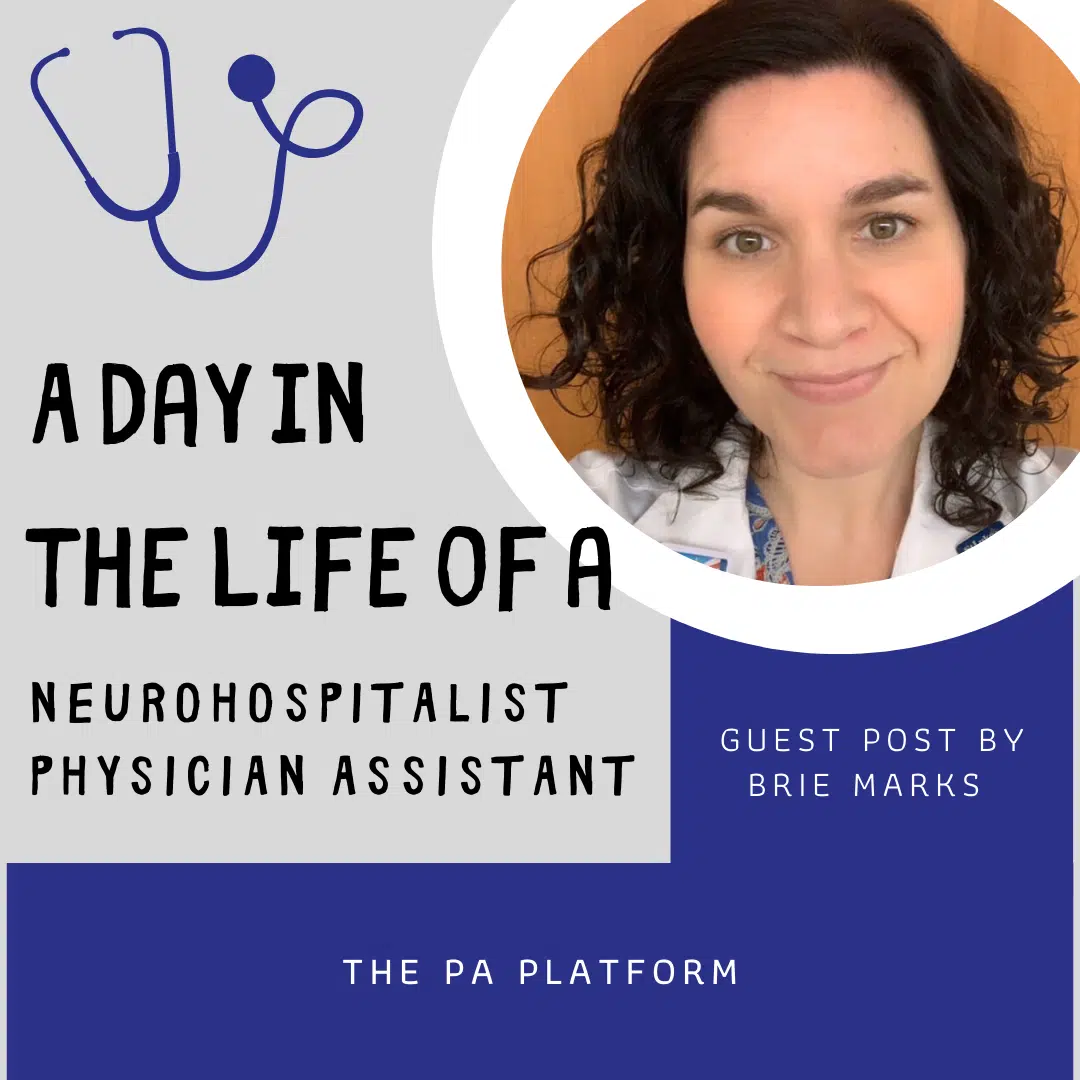
My name is Brie Marks and I’ve been a practicing PA for 5.5 years. I graduated from DeSales University in eastern Pennsylvania in 2014 and am currently loving my job in Inpatient Neurology/ Neurological Acute Care. As a Neurohospitalist PA, I work in the hospital only. I actually haven’t spent any time in an outpatient office since I was doing my clinical rotations! Our health network is comprised of multiple hospitals, so I spend some of my time at our main hub, which is an academic center, and some of my time in our community hospitals. I’ve always been fascinated by the brain and neuroscience, and Neurology is a perfect fit for me because it is both very specialized (one body system) and also covers so many topics. Common illnesses and injuries that I see on the inpatient service include stroke, seizure, intracranial hemorrhages, spinal cord injuries, infections of the brain and spinal cord, auto immune diseases and neuro-degenerative diseases like Parkinson’s Disease and ALS.
A “typical” day for me is based on my location.
-
If I’m at our main hospital, I meet with my team for rounds at 8am, where we discuss all of our patients for that day and divide them up between the Advanced Practitioners (PAs and NPs) and the Attending Physicians.
-
I then go see new consults and follows ups, trying to prioritize the sickest patients or who may be being discharged that day. On our service, the Advanced Practitioner (AP) generally does all of the chart review, touches base with the primary team, looks at all of the imaging, performs the history and physical and comes up with a diagnosis and plan and then discusses or “staffs” that patient with the attending physician. I truly have the most amazing team of APs and docs – its an incredibly supportive environment for learning and growth!
-
If I’m at a community hospital, I “run the list” (decide which patients need to be seen) by myself, assess patients and either meet up with the attending physician later that day in person or speak with them over the phone.
I work 40 hours a week, roughly 8am-4. I take my turn working holidays and weekends, which is standard for an inpatient job. I finish my day at 4, though as with any inpatient job, there are occasional emergencies that need to be handled right away. Some of my colleagues work 4 – 10 hour shifts and are scheduled until 5 pm, so I leave late fairly rarely. I work 1-2 holidays a year, and when I work on a weekend, I get 1 weekday before and 1 weekday off after that weekend. I do not take any “call” – meaning that once I leave the building, I am not contacted after hours or have to respond to emergencies. I am a salaried employee, so I do not get paid extra for staying late, but there are times I leave early for an appointment or another obligation and it all generally evens out.
A common question that I am asked is – how much autonomy do you have as a Neuro PA?
On my team, I am quite autonomous, but definitely feel that I have the support of my fellow APs and physicians. We frequently meet as a team to discuss difficult cases, both as a brainstorming session as well as a learning opportunity. At our main hospital, the Attending Physician will generally speak to the patient after I have examined them, which gives the patient an opportunity to ask any questions that have come up in the meantime. If there is an emergency or a stroke alert when I am at a community hospital, I respond to the emergency independently and then contact my attending with my assessment. As a PA on the Neuro service, I feel very heard and respected as a provider in my own right, but always have my team of docs to ask questions to and learn from.
Neurology is an incredible field. I would encourage students not to be intimidated by the neuro exam or the complexity of the neuro material that’s covered in PA school. If someone is passionate about the topic, it is absolutely possible to master it while on the job. There are so many opportunities, including as a neurohospitalist, general outpatient neurology, or even to further subspecialize in areas like epilepsy, multiple sclerosis, movment disorders, headache, etc.
Thank you to the PA Platform for allowing me to share some of my experiences as a Neuro PA. I feel so fortunate to have become a PA and would choose this career 100x over. The struggle to get there is definitely worth it! Please feel free to reach out with any questions- I’m always happy to help. I can be found at Betweentwostethoscopes on Instagram, where I share insights into my life as a Neuro PA, as well as exam tips, neuro imaging and case studies.